
National Office
Please enter the office location/term above to receive results for your closest office as well as information matches
National Office
Please enter the office location/term above to receive results for your closest office as well as information matches
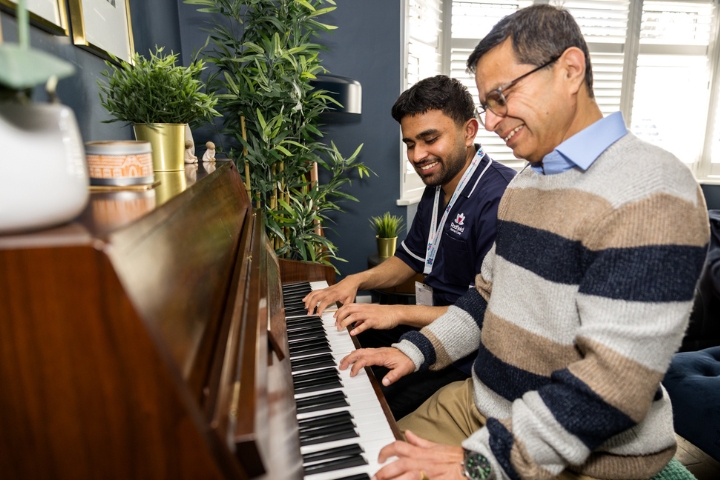
Music and memory have a powerful connection. For people living with dementia or memory loss, familiar music can sometimes unlock memories, emotions and connections when other forms of communication become more difficult.
You may have seen the viral video from a few years ago. A very frail ballerina, Marta Cinta González Saldaña, who had Alzheimer’s, listens to Swan Lake through headphones, and begins to dance again. It’s a very emotional watch and demonstrates so clearly the powerful link between music and memory.
As Lyndsey Winship wrote in the Guardian: “… suddenly her eyes flash and she’s Odette the swan queen at the misty lakeside, arms raised. She leans forward, wrists crossed in classic swan pose; her chin lifts as if she’s commanding the stage once more, her face lost in reverie.”
The connection between music and memory is extraordinary. It appears that while dementia progressively erodes language and cognitive faculties, musical memory often remains apparently untouched. It’s something that our Care Professionals at Radfield Home Care Shrewsbury & Oswestry see time and time again.
As Gemma Baugh, our Registered Care Manager says:
“It’s amazing to see people at our day centres, who might be a little withdrawn or quiet, come alive and start singing – and sometimes dancing – when the music begins.”
Music seems to reach the brain in remarkable ways and acts as a bridge to the past, as well as improving cognition and emotional well-being for people living with dementia. The science behind this phenomenon is interesting. Brain imaging shows that musical memory is stored in different areas of the brain from our memory of everyday events or our structured knowledge about the world. To get technical, it’s located in particular regions of the medial prefrontal cortex. These musical regions of the brain are often the last to be affected by Alzheimer’s disease or other forms of dementia.
Music actually stimulates a “whole brain” workout, triggering the release of feel-good neurotransmitters like dopamine and reducing cortisol, the so-called stress hormone.
Adrian Plant, one of the team of people who presents Your Memories Matter, a Shrewsbury-based radio show scientifically designed for people with memory loss, is a passionate believer in the power of music. As he says: “familiar tunes can soothe anxiety, restlessness, and the “sundowning” effect often experienced in the evening by people living with dementia. It’s a beautiful thing to see in action.”
Adrian also runs dementia-friendly singing sessions and believes that music from our teenage years and twenties acts as a “memory bump”, because that’s when we have new and formative experiences, as well as feeling new emotions and building social bonds – like falling in love, moving home or, in the ballerina’s case, dancing a first leading role.
Music can also act as a tool for communication for family members and carers. Sharing songs can help people connect and break through isolation – especially when language is difficult. For some people, they may not be able to articulate how they’re feeling or what they need, but will happily sing along to a familiar tune.
Here at Radfield Home Care, we’re always looking at ways to inspire the people we care for. In fact, being inspired is one of our core values and part of what we call the “Be There” movement.
We love using music to help people feel connected with themselves. For example, Jane, one of our Care Professionals, regularly sings with one of the people she cares for. Her client requires bed-based support and sometimes gets agitated. Jane will often sing to her, and she’ll join in, which has both a calming and restorative effect.
Like many creative approaches, music is entirely personal. It’s better to choose music that is deeply personal. Music from our youth, wedding songs, or our first dance – will often be the most effective.
Generic classical music, although soothing, isn’t always the answer. While it is perhaps true to say that music isn’t a cure all, it is a profound tool to improve the quality of life for someone living with dementia and their carers or family.
For families supporting someone with dementia, creating a personalised playlist can be a simple and meaningful way to explore memories and encourage connection. Think about favourite songs, artists, music from teenage years, wedding songs or tunes associated with important moments in someone’s life.
A final recommendation from Adrian Plant: “It’s really good to build personalised playlists or soundtracks for people who are dealing with memory loss. Not only is it an excellent way to help the person to reminisce, it can also spark a renewed connection through music.
“Because, after all, when memory begins to fade, the rhythm of the soul remains.”
At Radfield Home Care Shrewsbury & Oswestry, we’re passionate about finding meaningful ways to support people living with dementia and memory loss. Music is just one of the ways we can help people remain connected to themselves, their memories and the people around them.
Our local care team provides personalised home care and support across Shrewsbury, Oswestry and the surrounding Shropshire communities, always focusing on the individual and the things that matter most to them.
If you would like to find out more about dementia care, home care or support for someone living with memory loss in Shropshire, please contact our friendly team.
You can also find out more about Your Memories Matter, the Shropshire radio programme we are proud to support, and how you can get involved by sharing your own memories, stories and favourite songs.

Richard combines senior leadership experience with hands-on care expertise to ensure our clients and their families feel valued and connected to their local community.
Read moreGet in touch with your local Radfield Home Care office today and find out more about the support we offer and the difference we can make.