What if I told you that only 4% of UK business owners ever reach £1 million in annual turnover?
It’s a sobering statistic from City AM’s research. Even more striking: of that elite 4% who cross seven figures, only 10% reach £10 million. That means just 0.4% of all UK business owners ever build a truly substantial enterprise.
Yet here’s what most people don’t discuss: reaching £1 million turnover means nothing if you’ve built a business that leaves you burnt out, disconnected from your purpose, or compromising on values.
This is the tension at the heart of entrepreneurship – particularly in care. Can you build a genuinely profitable business whilst delivering exceptional care? Can you reach that £1 million milestone without sacrificing quality, burning through staff, or losing sight of why you started?
At Radfield Home Care, our franchise partners prove every day that the answer is yes. Our three-year projections show franchise partners reaching £1.2 million in turnover – placing them in that top 4% of UK businesses. But what makes this different is how they get there.
In this article, you’ll discover why so few businesses reach seven figures, what care sector statistics really tell us, and how Radfield’s purpose-driven BeThere movement isn’t just good ethics – it’s brilliant business strategy.
Because building a £1 million business matters. But building one that actually makes a difference matters more.
According to research from Warwick Business School’s Enterprise Research Centre, just 2% of surviving start-ups registered in 2020 achieved £1 million turnover after three years. Think about that: 98% of businesses that survived still couldn’t reach seven figures.
City AM’s analysis reveals the broader picture: only 4% of business owners ever reach the £1 million mark. According to UK Government statistics, the UK has approximately 5.5 million private sector businesses. In 2023, the average UK business earned £806,000 annually – respectable, but not seven figures.
There’s a phenomenon called the “complexity ceiling” – when the skills and systems that got you to £500,000 simply can’t take you further.
Here’s the maths that should worry any entrepreneur: if a business generating £500,000 grows at 3% per year (matching inflation), reaching £1 million takes twenty-four years. That’s not growth. That’s treading water.
Businesses that break through master three things:
Most business owners remain excellent technicians but struggle to build a genuine business that scales beyond their personal capacity.
When Radfield franchise partners reach £1.2 million by year three, they’re:
But here’s what makes it remarkable: Radfield franchise partners achieve this whilst maintaining low staff turnover in the sector, delivering award-winning care quality, and building businesses they’re genuinely proud of.
Most businesses face a trade-off: growth or quality. Scale or satisfaction. Profit or purpose.
Radfield franchise partners prove this is a false choice.
The UK home care sector presents one of the most compelling business opportunities in the country. It’s also one of the most challenging to get right.
According to Office for National Statistics projections, the UK population aged 85+ will reach 5 million by 2035. Government “home first” policies are systematically shifting care away from residential facilities. Private-pay clients increasingly demand premium, relationship-centred care at home.
This is demographic destiny. People are living longer and want to age at home. Demand for high-quality home care will only increase over the next 20-30 years.
Despite massive demand, many home care providers barely break even. The Homecare Association’s 2025 Homecare Deficit Report reveals the brutal reality: a £3.25 billion annual funding gap across UK homecare.
As Dr Jane Townson OBE, Chief Executive of the Homecare Association, states:
“A fair price for care is not an optional extra – it is the foundation of a sustainable health and care system.”
When you can’t pay staff properly because funding doesn’t cover costs, consequences ripple through everything. This is why, according to Skills for Care, the adult social care sector faces 28.3% average staff turnover. Nearly one in three care professionals leave every year, causing:
Many care business owners end up exhausted and underpaid – not because they lack business acumen, but because the publicly-funded model is mathematically unsustainable.
When the Homecare Association confirms that only one public organisation in the entire UK pays adequately for care, the message is clear: sustainable care businesses must operate in the private-pay market.
Private-pay clients aren’t looking for the cheapest option. They’re looking for continuity, quality relationships, flexibility, and peace of mind. They’ll pay £40+ per hour because they understand the value.
This pricing allows Radfield franchise partners to:
This isn’t about exploiting vulnerable people. It’s about charging what care actually costs to deliver properly – something the public sector has systematically failed to do, as the £3.25 billion funding gap proves.
UK Homecare Funding Crisis (Homecare Association 2025) – Published 21 Nov 2025:
Radfield’s Private-Pay Model:
Here’s what separates Radfield franchise partners who reach £1.2 million from the 96% of UK businesses that never hit seven figures: they understand that BeThere isn’t just our care philosophy. It’s our competitive advantage.
At Radfield BeThere directly drives business performance.#
Industry average staff turnover: 28.3% (Skills for Care) Radfield staff turnover: 4.2%
That 24.1 percentage point difference is the foundation of sustainable profitability. When care professionals stay:
This creates a virtuous cycle: exceptional care → happy clients → strong referrals → business growth → ability to pay carers properly → staff retention → exceptional care.
The Homecare Association’s 2025 Deficit Report confirms what Radfield has known: publicly-funded care rates don’t cover quality care costs. With a £3.25 billion funding gap and 29% of councils paying below National Living Wage costs, building on public contracts means building on quicksand.
Private-pay clients value quality, continuity, and relationships. This allows Radfield franchise partners to charge the Homecare Association’s Minimum Price or above, enabling:
The Radfield Runway – our onboarding programme won the Princess Royal Training Award in 2022 and 2025.
1:2 Support Ratio – this is why we won ‘Team Support from Head Office’ at the 2023 Home Care Awards and Workbuzz Five-Star Franchisee Satisfaction three consecutive years (2023-2025).
40+ Years Heritage – Dr Hannah MacKechnie and Alex Green remain actively involved. You’re partnering with people who’ve been in care since the 1980s, not distant corporate executives.
Ed Gill and Rob Dancy separately worked as franchise consultants at Radfield National Office awarding franchises before becoming franchise partners themselves. When the people who know the model best choose to invest their own money, that validates everything about sustainable, purpose-driven growth.
Year 1: £170,000-210,000 turnover
Year 2: £700,000-850,000 turnover
Year 3: £1.0M-1.2M turnover
From Alex Green, CEO:
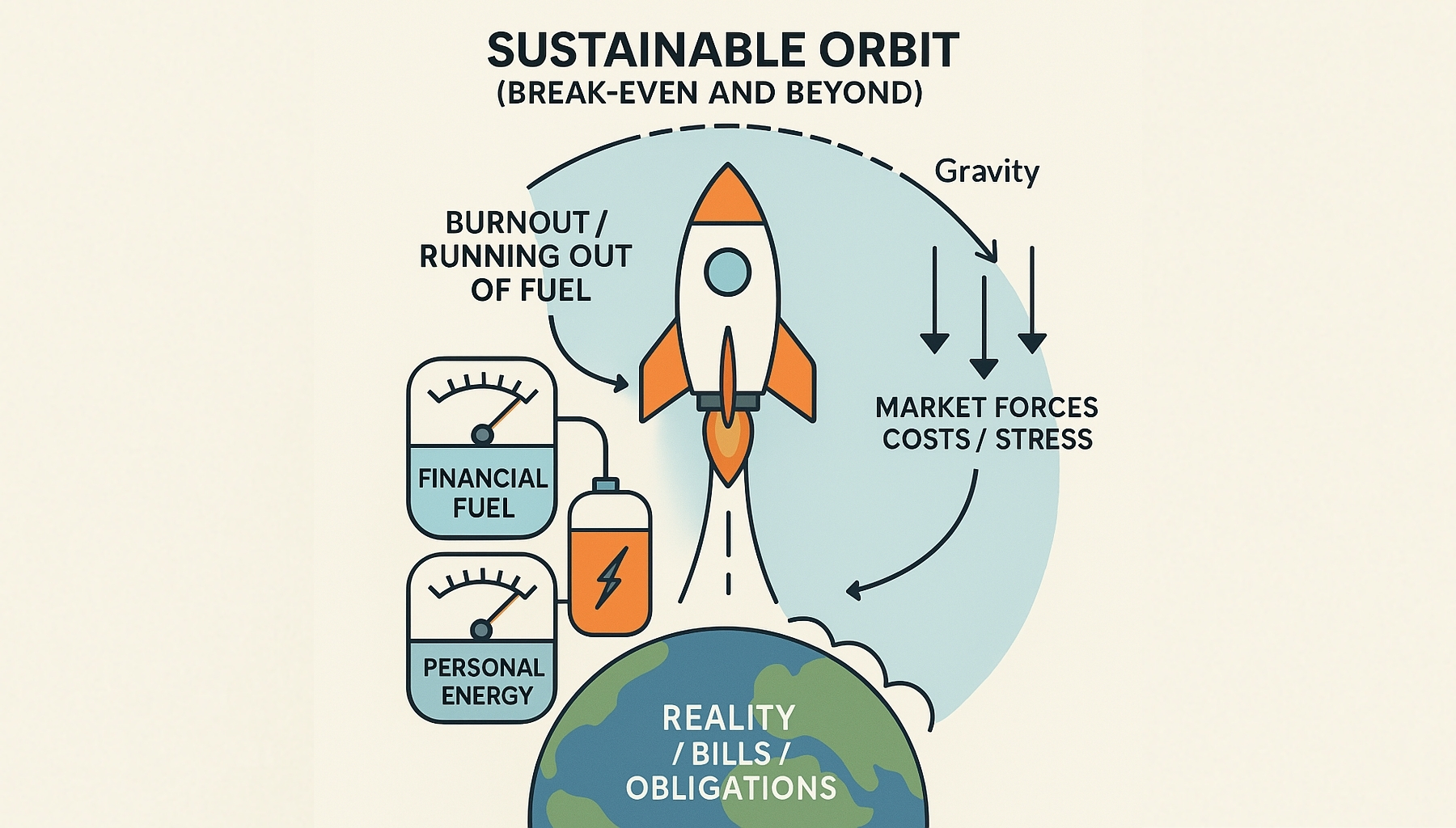
Launching a business is like launching a rocket into space. You need to reach orbit (break-even) before your fuel runs out. You have two types of fuel:
Financial Fuel: Investment, working capital, reserves.
Personal Energy Fuel: Enthusiasm, resilience, drive, emotional capacity.
Both are finite. Both can run out before orbit.
If you don’t reach orbit before fuel runs out, gravity pulls you back to earth. You run out of money or personal energy to drive the business forward.
When you reach break-even at month 10 instead of month 24, you preserve:
Once you reach orbit, everything changes. Gravity no longer pulls you down. Financial fuel regenerates through profit. Personal energy regenerates through success.
Our Radfield Runway programme, 1:2 support ratio, and exclusive private-pay focus (avoiding the £3.25bn funding gap) all accelerate your path to orbit.
Client Base × Hours Delivered × Hourly Rate = Revenue
Year three success typically means:
Total investment: £125,000 (typical minimal total investment)
Ongoing fees: 6% total (5% management service fee + 1% marketing levy)
Year three at £1.2M turnover:
ROI: 160% annual return by year three
Compared to care businesses focused on public contracts: with 29% of councils paying below National Living Wage costs, many operators barely break even or operate at a loss.
Successful franchise partners share these characteristics:
You don’t need previous care experience. Roughly 50% of Radfield franchise partners come from non-care backgrounds.
Complete the Radfield Franchise Fit Quiz →
This evaluation helps determine whether your motivations and goals align with Radfield’s success factors.
Radfield has 33 trading offices with seven in launch. We’re growing strategically, not aggressively. View current franchise partner locations.
Territories are sized based on Census demographic data, accessibility, competitive landscape, and private-pay market potential.
Based on actual Radfield franchise partner performance. Several franchisees have reached £2M+. Validated by Elite Franchise #44 ranking and three consecutive years of Five-Star Franchisee Satisfaction.
The Homecare Association’s 2025 Report documents a £3.25 billion funding gap. Only one public organisation pays adequate rates. With 29% of councils paying below National Living Wage costs, it’s mathematically impossible to build a profitable, quality business on public contracts whilst paying staff properly. Radfield’s private-pay focus ensures sustainable 15-20% margins and 4.2% staff turnover vs 28.3% sector average.
Three key differences: (1) UK-owned with family heritage since the 1980s vs US corporate ownership, (2) 1:2 support ratio vs larger networks, (3) Exclusive private-pay focus protecting you from the £3.25bn funding gap vs mixed models exposed to public sector underfunding.
Typically 9-12 months. Significantly faster than industry averages (18-24 months). The rocket fuel analogy explains why: shorter timelines conserve financial and emotional fuel, dramatically increasing success likelihood.
6% total (5% management service fee + 1% marketing levy). Competitive with or lower than most franchises. As British Franchise Association members, we maintain transparent, ethical practices.
Only 4% of UK business owners ever reach £1 million. Fewer still build businesses that genuinely matter.
Radfield franchise partners prove you don’t choose between profit and purpose. BeThere is a competitive advantage. It’s why our staff turnover is 4.2% versus the sector’s 28.3%. Why every CQC-assessed office is rated Good or Outstanding. Why we’ve won Five-Star Franchisee Satisfaction three consecutive years.
In a sector where the Homecare Association documents a £3.25 billion funding gap, Radfield’s private-pay model isn’t just ethical – it’s the only sustainable path to building a genuinely profitable care business delivering exceptional quality.
Schedule your discovery call with our franchise team →
Director of Franchise Development Phil MacKechnie and Franchise Consultant John Overdijking work closely with all prospective franchise partners to ensure alignment and provide territory-specific projections.
Because joining the top 4% of UK businesses matters. Building something that actually makes a difference matters more.
Phil MacKechnie is Director of Franchise Development at Radfield Home Care Franchising, working alongside CEO Alex Green and Managing Director Dr Hannah MacKechnie. Originally from New Zealand, Phil helps entrepreneurs build profitable care businesses that genuinely improve lives.
My passion is to help home care business owners start and grow their businesses and promote Radfield’s purpose and mission.
Read moreGet in touch with your local Radfield Home Care office today and find out more about the support we offer and the difference we can make.