
National Office
Please enter the office location/term above to receive results for your closest office as well as information matches
National Office
Please enter the office location/term above to receive results for your closest office as well as information matches
In this home care for couples guide, we explore how professional home care provides a pathway for couples to remain in their familiar environment, preserving their shared history while receiving bespoke support tailored to their individual requirements.
Yes. Home care allows a couple to remain within the sanctuary of their own home, the place where their memories are woven into the very fabric of the building. By introducing Care Professionals into the home, we provide the necessary support to bridge the gap between independence and safety.
We believe that staying together is not just a preference; it is often fundamental to a person’s wellbeing.
When we support a couple, our primary goal is to maintain the “status quo” of their relationship as much as possible. Whether they have been married for sixty years or have found companionship later in life, the emotional anchor of a partner is irreplaceable.

Addressing the needs of two people means creating a care plan that respects the autonomy of both. We look at the rhythms of the home, what time they like to eat, how they prefer their tea, and what their evening routine looks like.
By integrating into these existing patterns, our Care Professionals can provide support that feels like a natural extension of the home rather than an intrusion. This holistic approach ensures that the “well” partner is supported just as much as the partner with more acute health needs, preventing burnout and allowing them to return to being a spouse rather than just a carer.
Supporting a couple is a distinct discipline from supporting an individual. In many cases, one partner may have taken on the role of an informal carer for the other, often at the expense of their own health and vitality. We see our role as supporting the whole household. This involves identifying where the pressures lie, and taking that pressure off your parent’s shoulders.

It is common for one partner to require mobility support while the other may be navigating the early stages of dementia or a chronic condition like Parkinson’s. Personalised home care is uniquely suited to this challenge because it is inherently flexible. We do not apply a “one size fits all” model. Instead, we assign Care Professionals who have the specific expertise required for each partner’s condition.
For example, a morning visit might involve one Care Professional assisting one partner with complex mobility needs and personal care, while another focus is placed on cognitive stimulation and companionship for the partner with memory loss.
We adapt our techniques, whether that is using specialist equipment for transfers or employing therapeutic communication strategies, to ensure that both individuals receive the highest standard of clinical and emotional support.
Because we operate in the private sector, we have the luxury of time. We can spend the hours necessary to ensure that care is unhurried and that transitions between different types of support are seamless. This adaptability is key to helping people age well; as needs change, our care evolves, ensuring the couple remains safe in the home they love.

In a standard UK residential care home, fees are calculated per bed, not per room. If both Mum and Dad require residential placement, you are essentially paying double the cost to secure two beds. Even if they share a room, the financial burden routinely doubles, frequently costing between £2,000 and £3,000+ per week for a couple.
Home care for couples presents on average a much more financially viable and emotionally supportive alternative, depending on your specific needs of course. Whether opting for structured visiting care or full-time live in care for couples, the pricing is based on the household rather than per person.
With live in care, a dedicated Care Professional resides in the couple’s home. While there is a modest “couples supplement” added to account for managing the care plans of two distinct individuals, it is usually much more cost-effective than paying for two separate care home beds. This allows couples to keep their capital, retain ownership of their family home, and stay together in the environment they love.
There are several non-means-tested resources designed to help offset the cost of care for a couple.
Attendance Allowance is a tax-free, non-means-tested welfare benefit paid by the DWP to individuals over State Pension age who require physical assistance or supervision due to illness or disability.
Because it is completely independent of income or savings, both partners can claim Attendance Allowance simultaneously if they qualify. This means a couple can unlock two streams of weekly funding to put directly toward their home care fees.
The 2026/2027 Attendance Allowance rates are structured across two tiers:
If both parents qualify for the higher rate, this brings an additional £229.20 per week (£11,918.40 per year) of tax-free funding into the household to support their independent living goals.
If one or both partners have complex, intense, or unpredictable medical needs such as advanced stages of Parkinson’s or specialised dementia care requirements, they may be eligible for NHS Continuing Healthcare (CHC).
CHC is a package of care fully funded by the NHS. It is entirely based on clinical need rather than financial wealth. During our initial care consultation, we can help guide your family on how to request a CHC screening from your local Integrated Care Board (ICB).
If the couple’s combined capital and savings fall below the local threshold limits, your local council may contribute toward the cost of home care for older parents. Even if your parents are self-funders, you have a legal right to request a free Local Authority Care Needs Assessment for both Mum and Dad to establish exactly what support is recommended. You can find out more about the cost of home care in 2026 in a guide written by our experts here.
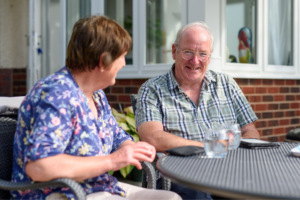
For a couple navigating the challenges of later life, their surroundings are a powerful connection to their identity. The photos on the mantelpiece, the garden they planted together, and even the “his and hers” chairs in the lounge are vital anchors.
When a person is moved into an institutional setting, they often lose these tangible links to their past which research suggests can undermine an individual’s sense of identity. By choosing home care, you are choosing to preserve your parents’ shared history. Research has shown that being surrounded by one’s own possessions and memories is a cornerstone of mental wellbeing and ageing well.
Our Care Professionals are trained to value these histories. We take the time to learn about a couple’s life, their careers, their travels, and their family stories. By incorporating these elements into daily conversation and activities, we help maintain a sense of continuity. If a couple has always enjoyed a walk in the local park on a Tuesday, we make it our mission to facilitate that.
By keeping people connected to their community and their past, we help them maintain their sense of self during a time when health challenges can make them feel invisible.

While we treat the couple as a unit in terms of their living environment, we never forget that they are two distinct individuals with their own preferences, personalities, and goals. Personalisation is at the heart of everything we do.
In the context of a couple, personalisation might mean:
We understand that exceptional home care means respecting the little things. By providing a level of granular detail in our care planning, we ensure that neither partner feels their needs are being overshadowed by the other’s.
This level of dignity and respect is what defines a premium care service.

The consultation for a couple is a collaborative process. We sit down in their living room, usually over a cup of tea, and discuss how they see their future. We look at the physical environment, identifying any adjustments that might make the home safer, and we talk through the daily routines.
This is also the time when we address the concerns of the adult children. We know that you are often balancing your own lives, careers, and families while worrying about your parents’ safety.
The consultation is designed to provide peace of mind. We outline exactly how we can support both parents, how we communicate with the family, and how we handle emergencies. It is a roadmap for the future, built on transparency and expertise.

We suggest starting the conversation early, before a health crisis makes the decision for you. Use these strategies to guide the discussion:
We are here to guide you through every one of these steps. Our expertise in the home care industry allows us to provide not just the care itself, but the professional advice and emotional support that families need during this transition.
Choosing care for your parents is one of the most significant decisions you will ever make. By opting for a personalised home care solution, you are giving them the gift of time together in the place they love most.
At Radfield Home Care, we are honoured to be the partners who help make that possible, ensuring your parents can age well, stay connected, and live life on their own terms.